By using this website, you agree to the storing of cookies on your device to enhance site navigation, analyze site usage, and assist in our marketing efforts. View our Privacy Policy for more information.
By clicking 'Accept all cookies', you agree to storing cookies on your device to enhance site navigation, analyze site usage and assist in our marketing efforts as outlined in our privacy policy.
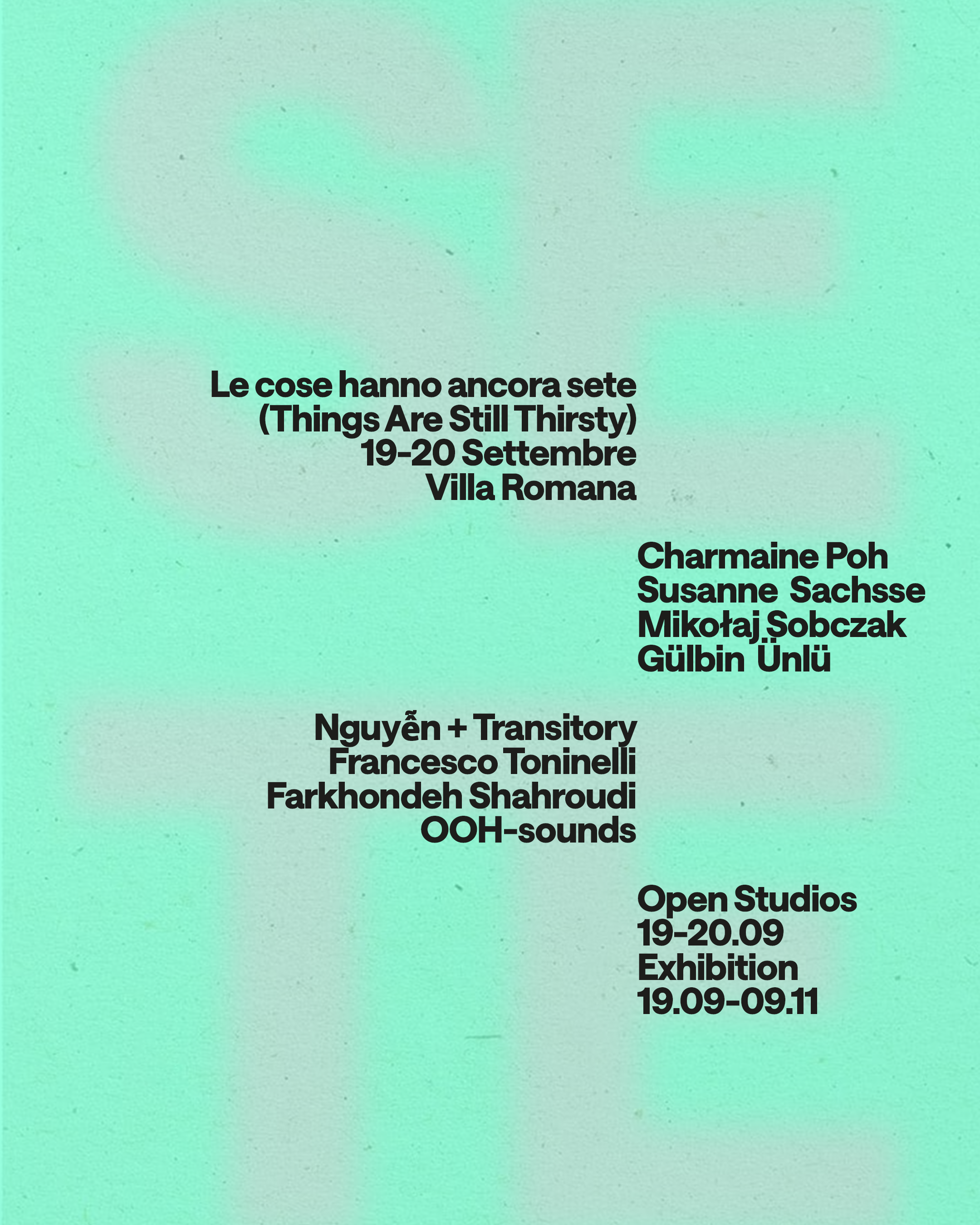
Open Studios with Villa Romana Fellows 2026 Charmaine Poh, Susanne Sachsse, Mikołaj Sobczak, Gülbin Ünlu.
with performances by Nguyễn + Transitory, Francesco Toninelli, and OOH-sounds.
Open Studios: 19-20 September 2026 19 September from 5pm to 11pm 20 September from 2pm to 6pm
Exhibition: 19 September - 9 November 2026
Opening: 19 Sept 2026 from 5pm until late weekly open: Wed-Fri, 2pm-6pm
Le cose hanno ancora sete (Things Are Still Thirsty)
Some things remain thirsty. Not only bodies, but houses, paintings, photographs, archives, windows, gardens, and stories. They absorb and retain, and they release. They carry traces of the lives and histories that have passed through them while continuing to make demands upon the present.
Thirst is not simply a condition of lack. It is a movement towards something beyond oneself: a form of openness, interdependence and maybe, above all, of desire. To thirst is to remain unfinished: permeable to water, memory, time and transformation.
The Italian word ancora is important here. It means that things are still thirsty, but also that they are thirsty again. It suggests persistence and return: something believed to be resolved, contained or overcome continues to resurface. What has been forgotten, suppressed or denied does not simply disappear. It remains present in bodies, images, materials and institutions, waiting to be encountered anew.
The exhibition takes place in a year marked by the memory of another body of water. In 2026, Florence commemorates sixty years since the flood of 1966. The disaster is remembered through images of streets transformed into rivers, artworks submerged, books destroyed by water, and mud entering houses, churches, workshops, and archives.
Yet the water did not simply pass through Florence. It entered the city’s material memory.
Long after the Arno receded, the flood remained inside things: in stains, sediment, warped wood, damaged photographs, swollen books, displaced objects and irreparable absences. It altered the material substance of what survived and revealed that preservation cannot always mean returning something to an untouched state. Sometimes it means learning to live with irreversible transformation.
The flood reminds us that things are not passive witnesses. They absorb history and carry its traces. They remember through their surfaces, their fragility and their altered forms, even when societies would prefer to turn a painful page. Water unsettles the distinction between inside and outside, preservation and transformation, body and environment. It exposes the fantasy that walls, archives or institutions can remain sealed against the world.
During Open Studios, Villa Romana itself might therefore be understood as one of these thirsty things: a house, a garden, an institution and a living archive whose boundaries are continually crossed. Its rooms become thresholds. Histories seep through walls. Artworks remain open: provisional and capable of entering relations that cannot be entirely predicted or controlled.
There is also something particular in the tradition of the Open Studios itself. For two days, the spaces in which work is usually made away from public view are opened up. The studios - the sancta sanctorum of artistic practice, spaces of concentration, accumulation, hesitation, experiment, failure and unfinished thought - cease to be private interiors and become places of encounter. What is usually protected from view is temporarily made permeable.
This opening does not simply transform studios into exhibition rooms. On the contrary, it allows the public to encounter work closer to the conditions of its becoming: surrounded by traces, tools, fragments, residues, unfinished gestures, and decisions still in motion. The distinction between process and result becomes less stable. Opening the studio means opening a threshold between intimacy and publicity, between what has already taken form and what may still change.
In this sense, Le cose hanno ancora sete also speaks to the Open Studios themselves. The works do not need to arrive as completed statements. They may remain thirsty: towards another image, another body, another history, another material, another possible relation.
Responding to their thirst does not mean satisfying it once and for all. It means remaining attentive to what things still ask of us.
Although each Fellow follows a distinct trajectory, these questions find different echoes in the practices of the Villa Romana Fellows 2026.
In sozialen Netzwerken teilen
Verwandte Programme
Keine Artikel gefunden.
Gallery
Keine Artikel gefunden.
Träger der Villa Romana und des Villa Romana-Preises ist der Villa Romana e.V. Hauptförderer ist die Beauftragte der Bundesregierung für Kultur und Medien Weitere Förderer sind die Deutsche Bank Stiftung, die BAO-Stiftung sowie projektbezogen zahlreiche Privatpersonen, Unternehmen und Stiftungen aus der ganzen Welt.
Das Kunsthistorische Institut in Florenz – Max-Planck-Institut (KHI) bietet eine kontinuierliche institutionelle Zusammenarbeit an und führt jährlich eine Forschungsarbeit mit einem der Villa-Romana-Preisträger*innen durch.