Veranstaltung
Keine Artikel gefunden.
Jul 31, 2023
Aug 5, 2023
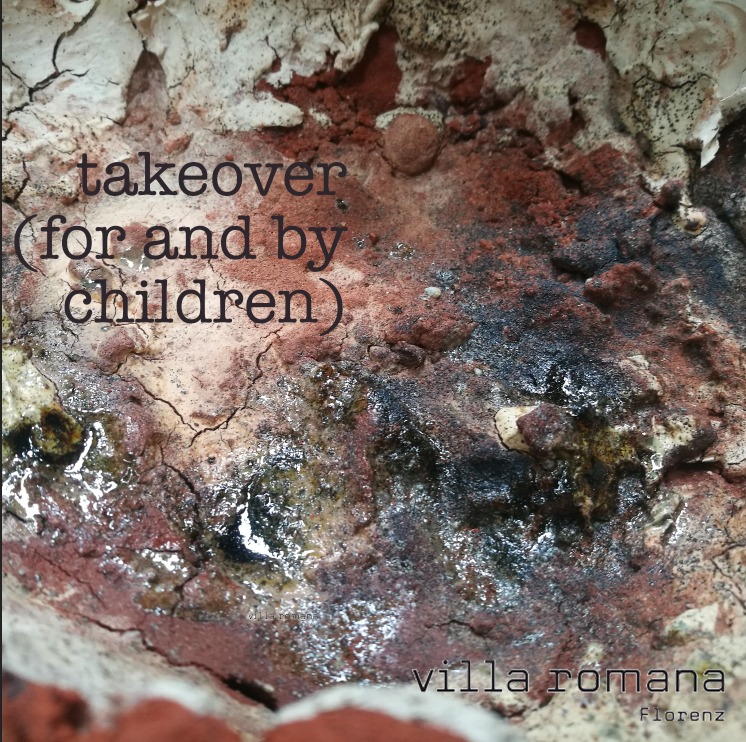
Between July 31st and August 5th 2023, Villa Romana will be taken over by a program designed, developed, and exhibited with, by, and for children, inhabiting the interface between art and education, while also participating firmly in contemporary art practices and discourses. Much has been happening at several scales in efforts to decentralise in order to decolonise artistic practices, bringing important political issues to discussion and pressuring necessary world changes. Inasmuch breakthroughs have been happening by shaking curatorial hierarchies, renouncing the dominance of object orientation and hearing and honouring non-hegemonic voices -, there is an eminent necessity to reintegrate joy and experience in the alternative worldings we are all engaged in through the arts. Children’s universes across cultures are permeated by primarily sensorial environmental experience. They practice daily in a dialogical non-anthropocentric forming of matter - objects in relation, relational objects, forming of objects in relation - as discussed in decolonial aesthetics and new materialisms. Children’s timeless play of creation and destruction and re-creation is an endless folding and unfolding of worlds - a generative purposelessness, a bodily trust, constant movement, sensuality and material-discursivity this project wishes to embrace and potentialise.
Archipel e.V. invites children for a week long participatory process of taking over Villa Romana, distributing contributions and collaborations in modules. The modules will take the form of different projects proposed to the children, in which each one of the organisers would be able to lead or support in different ways and configurations according to each module’s requirements and the children’s responses. As most of the organisers are parents, their children would be present and contributors as well. The main guideline is to work with an elemental and playful world experience and therefore planning on engaging with different qualities of earthly materials, sand, compost, rocks, allowing the momentary and also building micro-worlds in order to do micro-politics. The project fully embraces Villa Romana’s prioritising of an anti- discriminatory agenda in their program and believe that by working within this model we might be able to tackle issues of value, noticeability, inclusion, restitution, memory and acknowledgment in gentle and sensitive ways.
Artists:
Archipel e.V. (Monai de Paula Antunes, Silvia Noronha, Niko de Paula Lefort, Florian Bendsen) &Dudù Kouate
Education: Marzia Duarte&Ilaria Cavalini
Cultural Production: Carola Haupt
Träger der Villa Romana und des Villa Romana-Preises ist der Villa Romana e.V.
Hauptförderer ist die Beauftragte der Bundesregierung für Kultur und Medien
Weitere Förderer sind die Deutsche Bank Stiftung, die BAO-Stiftung sowie projektbezogen zahlreiche Privatpersonen, Unternehmen und Stiftungen aus der ganzen Welt.
Das Kunsthistorische Institut in Florenz – Max-Planck-Institut (KHI) bietet eine kontinuierliche institutionelle Zusammenarbeit an und führt jährlich eine Forschungsarbeit mit einem der Villa-Romana-Preisträger*innen durch.
Villa Romana e.V. wird gefördert von:

